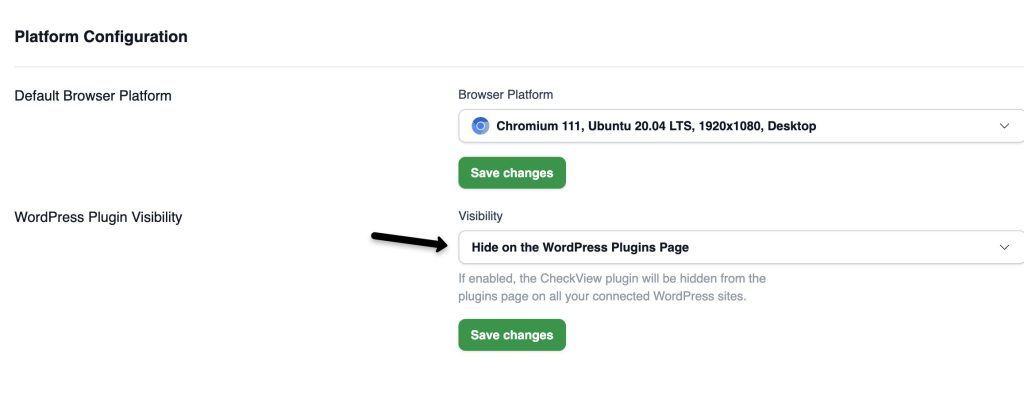
The Platform Configuration section of Organization Settings provides advanced control over the testing environment.
Default Browser Platform
All tests are run using the following default configuration:
Browser: Chrome
Operating System: Linux
Screen Resolutions: 1280×720 and 1600×900 (selected randomly per test run)
Device Type: Desktop or Mobile. Desktop tests use standard viewports. Mobile tests emulate real devices including iPhone SE, iPhone 11, iPhone 13, iPhone 14 Pro, Pixel 5, Pixel 7, and Galaxy S9+.
The Platform Configuration section allows you to define the testing environment at the organization level, ensuring your tests align with the real-world conditions of your target audience.
Available Configuration Options:
Auto-Retry Settings:
Enable or disable automatic retry for failed scheduled tests.
Test Mode:
Choose between Visual mode (full rendering with screenshots and video) or Fast mode (optimized for speed).
Device Type:
Select Desktop or Mobile device emulation for your tests. CheckView rotates between devices within the selected type to help avoid bot detection.
Respect Bot Restrictions:
Control whether CheckView respects robots.txt rules and noindex directives.
WordPress Plugin Visibility
CheckView includes a WordPress Plugin Visibility feature designed to help agencies and developers manage how the CheckView plugin appears on client sites. This setting provides a layer of white-labeling by hiding or rebranding the plugin in the WordPress admin area while maintaining full functionality and transparency for your team.
The Plugin Visibility setting is global across your entire CheckView account. When enabled, it will automatically apply to all connected WordPress sites within your account.
There are two key changes when this setting is turned on:
Hide from the Plugins Page: The CheckView plugin will be hidden from the Plugins > Installed Plugins page in the WordPress admin. This prevents clients from accidentally deactivating or deleting it.
Whitelabel the Settings Page The CheckView settings page in WordPress will be renamed to “Automated Testing” in the sidebar and header. This creates a more neutral, client-facing label without removing functionality.
Important Notes
This feature does not change the plugin’s folder name, internal API URLs, or references in the source code. Advanced users could still identify the plugin if they dig into the server or codebase.
These visibility changes are purely cosmetic and admin-facing, intended to reduce confusion for clients and simplify white-label deployment.
How to Enable
Log into your CheckView account.
Go to Account Settings > WordPress Plugin Visibility.
Toggle on “Hide on the WordPress Plugins Page.”
Click “Save changes.”
Once saved, the change will automatically propagate to all your connected WordPress sites within a few minutes.