
How Agencies Catch Silent Form Failures
A form that breaks loudly gets fixed the same afternoon. The costly ones break quietly. The page loads, the fields fill in, the submit button shows its thank-you message, and the entry never reaches anyone. Nothing on the site looks wrong, so nobody goes looking.
We asked three agencies that run CheckView across their client portfolios how they used to discover a failure like that, and what changed once their forms were on automated tests. One is Papaya Search, an SEO and SEM agency. Another is a Swiss digital agency that maintains more than 50 WordPress sites and asked us not to name it. The third is Rubber Duckers, a UK design and development agency that looks after its clients’ sites on care plans. Their answers were close enough to be worth putting side by side.
How they used to find out
For Papaya Search the signal was the numbers. As Bobby Kircher, the agency’s founder, put it:
“Before CheckView, if a form broke after an update or integration change, we might not know until we saw conversion data drop.”
For a search marketing agency that is a double problem. The client loses leads, and the conversion data the agency reports on is wrong for however long the form was down.
For the Swiss agency the signal was the client. Most of its clients are small and mid-sized businesses, and on most of their sites the contact form and the WooCommerce checkout are the only parts that bring in money. When one of them stopped, the agency would hear about it weeks later, when the client asked why things had gone so quiet.
For Rubber Duckers it was the client too, and more directly: a client tested their own contact form and found the enquiry never came through. Chris Key, the agency’s Creative Director, described what made it worse:
“The submission history showed it had been working at some point, so we never knew how long it had been down or how many enquiries were missed.”
None of those is a monitoring system. All three are what happens when there isn’t one.
Why checking by hand never kept up
The obvious fix is to submit every form yourself after every update. None of the three could make that stick. Papaya Search describes the switch as eliminating hours of manual site testing and QA. At Rubber Duckers, forms were checked when a site launched and occasionally after that, and testing never became part of the care plans “because of the hours involved.” The Swiss agency has between 50 and 100 forms and checkouts across its client sites, and Daniele M., its co-founder, was blunt about how manual testing at that scale goes:
“Testing all of them by hand was never realistically going to happen.”
It is not a discipline problem. Plugin updates land on different sites on different days, a spam-protection rule changes without anyone touching the form, and an email provider starts filtering notifications with no change on the site at all. A manual check covers the moment you ran it and nothing after.
What changed
All three agencies now keep their key forms and checkouts on scheduled CheckView tests. Each test submits a real entry on its own schedule, so a form that has quietly stopped delivering fails its next run instead of failing in silence. For the Swiss agency that turned “weeks later” into the same day:
“I don’t have to worry about it anymore. With over 50 sites under maintenance, if a form breaks I want CheckView to tell me, not the client.”
Rubber Duckers made it part of the care plan itself. Every form across its sites now runs on scheduled tests, and each test also confirms the notification email arrived:
“Every care plan client’s forms are now tested automatically, and we get told the moment something breaks rather than finding out from the client.”
The test history also answers a question that used to be guesswork: exactly when it stopped working.
What they singled out
Asked what they value most, Papaya Search and the Swiss agency pointed to the same thing, and it is not the alert itself. It is what comes with it.
Every test run keeps screenshots of each step, a video recording and the browser console log. Papaya Search calls out the visual confirmation as what makes troubleshooting efficient for its technical team. The Swiss agency says the same thing in fewer words: when a test fails, “I get a video showing exactly where it went wrong.” Nobody has to reproduce the problem before they can start fixing it, and across 50 sites that adds up to a lot of saved time.
Rubber Duckers pointed to the people behind it. As Chris put it:
“Knowing our care plan clients’ forms are being tested automatically is one less thing to think about each week. The support CheckView offers on top of that is up there with the best we’ve worked with. If something does go wrong, there’s a solid, helpful team behind it.”
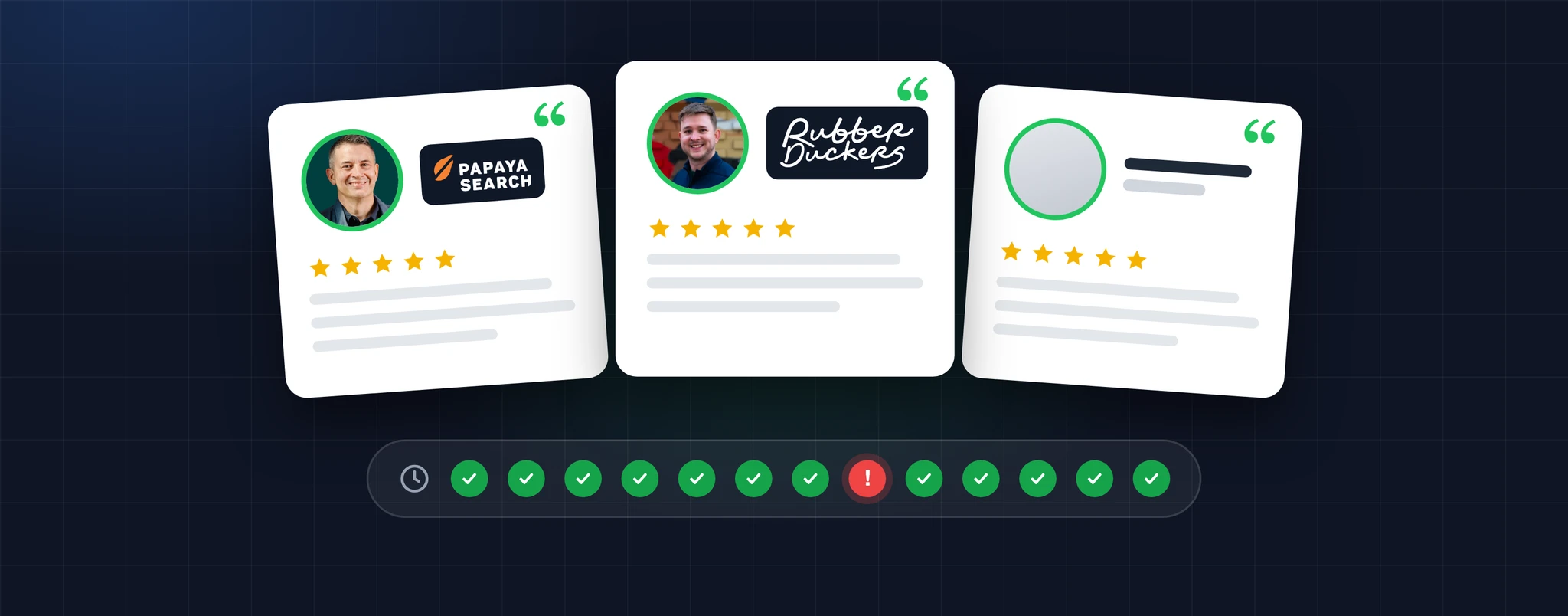
All three agencies rated CheckView 5 out of 5 and said they would recommend it.
Read the full stories
- Building Form Testing Into Every Care Plan: Rubber Duckers on making automated form testing a standard part of its care plans.
- Ensuring Conversion Reliability for SEO Success: Papaya Search on protecting conversion data across client sites.
- Catching Broken Forms Before the Client Does: a Swiss agency on keeping 50 to 100 forms and checkouts under automated tests.
If you run forms or checkouts across more sites than you can check by hand, you can see what a scheduled test catches on your own site with a free trial. Happy Testing!